 Lessons


This project more than a useful tool, is a fun project to build. It can be used in a vast variety of ways, to dress audio projects, to make a party lights, to test audio signals, or just for fun. It is also a great way to learn the properties of the transistor.
The circuit
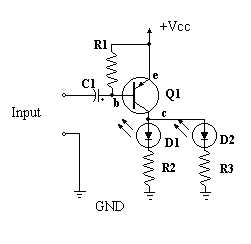
The audio indicator consists of three things: An indicator, a frequency switch, and an isolator. Knowing these three things needed, I thought of each one and came up with the following: LED's as indicators, a transistor as the switch, and a capacitor to isolate the current of the circuit from the audio source.
When an analog signal is introduced to the circuit, in this case an audio signal, it goes through the capacitor C1. This capacitor works as an isolator. It protects the audio source from making direct contact to the current of the circuit. The capacitor also works as a filter. Depending on the capacitance of it, it filters different frequenceis. I have choosen a 470 mfd capacitor because with this value you get most of the frequency range in an audio signal. Choosing a capacitor with a smaller capacitance would result in filter of higher frequencies, and you will not get a very defined indication response in the LEDs. The transistor responds better at lower frequencies.
The transistor Q1 is the frequency switch. The current pushed by the audio signal in the capacitor then goes through the transistor. This amplifies it by letting a higher amount of current go from the emitter to the collector. This action ocurrs when the base is saturated with a negative current which is produced when a low frequency pulse from the audio signal enters the capacitor. As the current from the base increases or decreases, the output of the collector is higher or lower respectively. This is then connected to a resistance that protects the LEDs from excessive currents. This is then directly connected to the anodes of the LEDs.
One last thing to mention in the circuit is a resistance connected to the capacitor. Capacitors tend to discharge when other components take current from them if they are not being recharged. This resistance is connected to the positive side of the capacitor and to the positive pole of the power input. The resistor is constantly supplying current to the capacitor so that it can keep conducting current through the base of the transistor. If this resistor was not there, the circuit will work for less than ten seconds and the indicator would gradually dim until it turns compleatly off. This is due to the lack of current in the base of the transistor that is needed to turn the transistor on.
Uses of the circuit
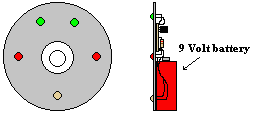
This project can be used in an infinity of ways. Some of them can be useful, some for decoration, or simply just for fun. In my case, I used it as decoration for my room. I drilled five holes on a non useful CD and inserted one LED in each hole. I then connected them in parallel to the output of the circuit (the resistance from collector of the transistor). I put the circuit on the back of the CD and glued a 9 volt battery vertically to the CD so that it could support the CD sright up as well as to supply the power to the circuit. I put the circuit on my stereo system and connected the output of one speaker channel to the input of my device, and every time I turn my stereo on, I have a rythmic light that decorates my room giving it a taste of technology.
Other way of use I thought for this device was to make a rythmic party light. Instead of using the transistor 3906, you can use one that can handle more current; the A1357. This way you can make it drive not only LEDs but also light bulbs. You can use different colors and types (only when they are between the current and voltage range), and you can use reflectors to increase illumination. This makes it one of the best uses for this device. Note: To use light bulbs, take the resistors R2 and R3 off the circuit and directly connect the light bulbs to the ground.
Just as these two examples thre are too many more to menction. Now I'll leave it to your own criteria. You can modify it the way you want to make it do what you want. Go ahead; twist it, enlarget, shrink it, or even squash it. : ) It's all yours!
The PC board
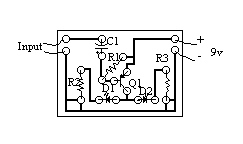
This circuit will look and work better on a PC board. Here is the one I designed for it:
Materials
- R1 - 1 K
- C1 - 470 mfd, 16 vcd
- Q1 - 3906 PNP Transistor
- D1, D2 - Diodes LED
Voltage Controller | Back To Menu | More to come!
Questions, comments, or suggestions, e-mail me at ChidoDavido82@yahoo.com